
No products in the cart.
Minted or Cast: Choosing a Gold Bar Format

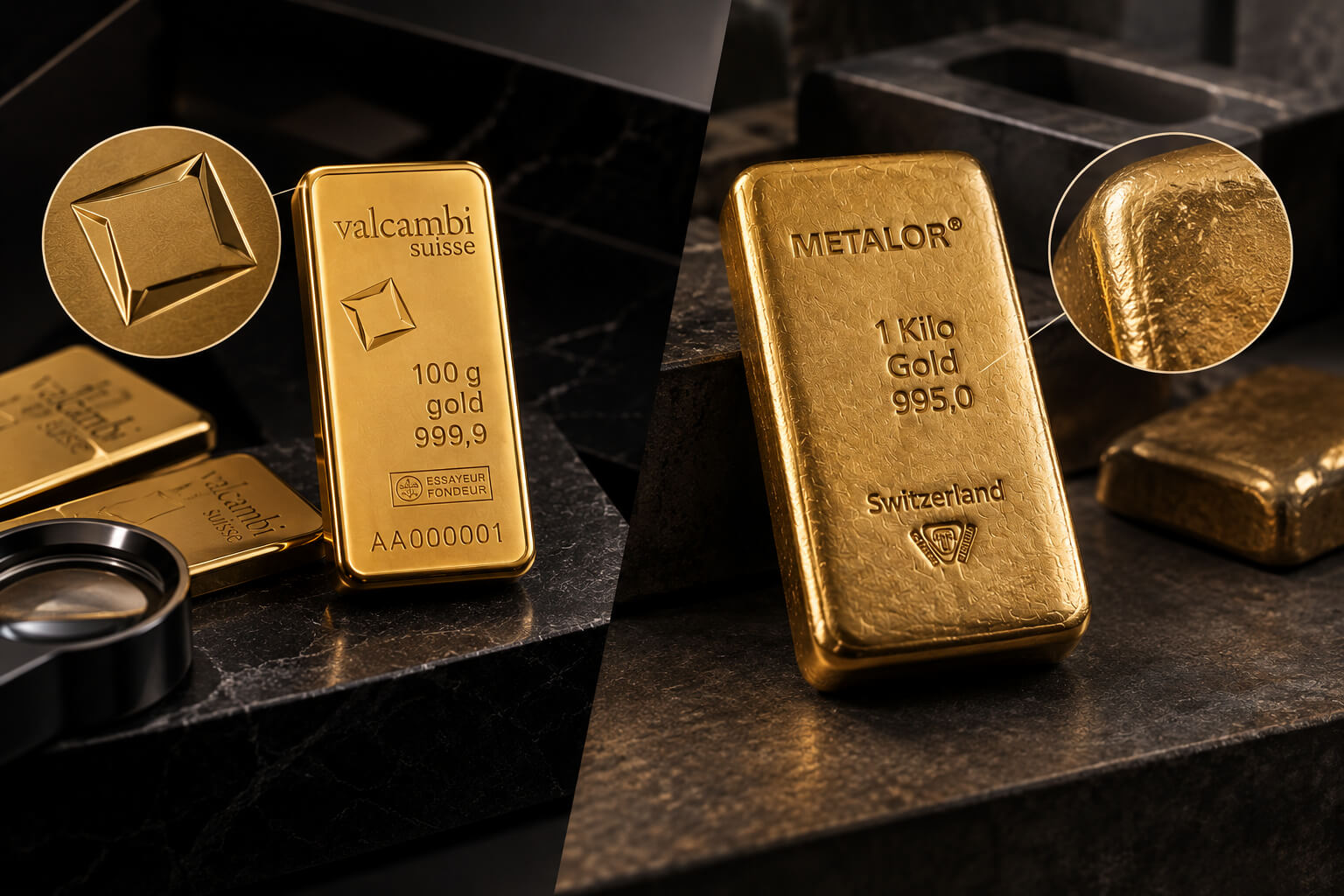
Not every gold bar is manufactured in the same way.
Some bars have sharp edges, uniform dimensions, highly controlled surfaces and presentation packaging.
Others have a heavier traditional appearance, with surfaces that reveal more of the casting process.
These physical differences often come down to two broad production formats: minted bars and cast bars.
Both can represent high-purity investment gold.
The distinction is mainly about how the product is manufactured, finished and presented.
Understanding the difference can help buyers know what to expect before choosing a physical gold product.
What Is a Minted Gold Bar?
Minted bars generally begin with refined gold that is processed into highly controlled blanks.
Those blanks can then be cut to precise dimensions before receiving markings and finishing.
The result is typically clean and consistent.
Minted bars commonly feature:
- Precise edges
- Uniform dimensions
- Smooth finished surfaces
- Detailed markings
- Carefully controlled presentation
- Protective packaging on many smaller products
This format is common among smaller investment gold bars.
A product such as a 5 Gram Valcambi Swiss Gold Bar reflects the compact, refined appearance many buyers associate with minted bullion.
What Is a Cast Gold Bar?
Cast bars use a different production process.
Refined molten gold is poured into a mold and allowed to form a solid bar.
The finished product is then marked with its identifying information.
Because the manufacturing method is different, cast bars can show more natural variation in:
- Surface texture
- Edge shape
- Dimensions
- Pour marks
- General appearance
This does not make the product lower quality.
It is simply a different physical presentation of refined precious metal.
Appearance Is Not the Same as Purity
One of the most important ideas is that surface finish does not determine gold purity.
A highly polished minted bar may be 999.9 fine gold.
A traditional cast bar can also be produced at high fineness.
The buyer should look at the actual specifications rather than assuming the more polished product contains better gold.
The primary bullion details remain:
- Weight
- Purity
- Refinery
- Product identity
- Authenticity
Finish comes after these fundamental characteristics.
Minted Bars Often Emphasize Precision
Minted products are designed to look highly controlled.
This precision can make them visually appealing.
The buyer may see consistent alignment, exact borders, detailed logos and clearly organized information.
For some buyers, this presentation adds confidence because every product looks deliberately standardized.
Minted bars can also be convenient for:
- Gifting
- Organized storage
- Smaller-denomination holdings
- Individually packaged collections
The physical presentation is part of the ownership experience.
Cast Bars Have a More Traditional Bullion Character
Cast bars often look closer to the industrial process that created them.
Their surfaces can appear less uniform.
Edges may not be as visually sharp.
Larger cast bars can feel substantial and utilitarian.
For buyers who appreciate a traditional bullion aesthetic, this can be part of the appeal.
The product looks like refined precious metal rather than a small packaged retail item.
That difference is subjective.
Some buyers prefer precision.
Others prefer physical character.
Weight Can Influence Manufacturing Format
Smaller bars are often well suited to minted production because the finished pieces can be produced consistently and packaged individually.
As bullion weights increase, cast formats become more common.
There is no absolute dividing line that says one weight must always be minted and another must always be cast.
Manufacturers choose formats according to their product range and production systems.
The buyer should therefore check the individual product rather than making assumptions based on weight alone.
Packaging Often Differs
Minted bars are frequently associated with protective retail packaging, especially in smaller investment sizes.
The package can help:
- Protect the surface
- Display refinery information
- Maintain organization
- Reduce unnecessary handling
Cast bars may be supplied more directly because their physical format is already more robust and less dependent on polished presentation.
This difference affects storage.
A collection of packaged small bars can occupy more space than the bare gold dimensions suggest.
Larger cast bars may need stronger storage because of their total weight.
Surface Marks Mean Different Things
A tiny mark on a highly finished minted bar can be visually noticeable.
The same type of mark may blend naturally into the surface of a cast product.
This is one reason owners should avoid judging different bar formats using identical cosmetic expectations.
Minted bullion is intentionally refined in appearance.
Cast bullion can show normal production character.
Neither observation should replace proper product verification.
Avoid Unnecessary Cleaning
The difference in finish can tempt owners to treat surfaces differently.
A minted bar with a fingerprint may encourage someone to polish it.
A cast bar may appear rough enough that an owner wants to “clean it up.”
Both reactions can be unnecessary.
Improper polishing, chemicals or abrasive materials can alter bullion surfaces.
The metal content does not require constant cosmetic maintenance.
Responsible storage is usually preferable to repeated cleaning.
Recognition Matters More Than Shine
When evaluating physical bullion, refinery recognition and product specifications matter more than how reflective the surface is.
Recognized refiners produce bullion to established standards.
A bar should communicate its:
- Weight
- Fineness
- Manufacturer
- Relevant identifying details
A glossy surface by itself proves nothing.
Likewise, a traditional cast finish does not indicate poor quality.
The product needs to be understood as a complete bullion item.
Minted Bars Can Support Smaller-Denomination Strategies
Buyers building gold holdings gradually may encounter many minted products because smaller weights are commonly offered in this format.
This can support a strategy involving several individual pieces.
For example, a buyer may accumulate:
- 5g
- 10g
- 20g
- 1 oz
- 50g
The exact mix depends on the available product range and buying objective.
Multiple bars can provide flexibility but also create more individual items to organize.
Cast Bars Can Simplify Larger Holdings
A buyer purchasing larger amounts of physical gold may prefer fewer individual pieces.
Larger products can reduce the number of bars required to represent the same total weight.
This can simplify:
- Inventory
- Storage organization
- Product counting
- Handling
The trade-off is lower physical divisibility.
An owner cannot sell part of one large bar while keeping the remainder in its original recognized form.
Premiums Can Differ by Format
Manufacturing and presentation contribute to the cost structure of physical bullion.
A minted bar can require additional production and packaging steps.
A cast product follows a different manufacturing process.
This can contribute to differences in premiums.
However, buyers should avoid assuming that one format always has a particular premium relationship.
Market demand, size, refinery and availability also matter.
Compare the actual products available at the time of purchase.
Format Should Match the Purpose
A buyer choosing physical gold should ask what matters most.
If presentation and smaller individual pieces are priorities, minted products may be appealing.
If the goal is concentrating more gold into fewer physical units, larger cast products may fit better.
Useful questions include:
- How much gold do I want in each individual piece?
- Do I care about presentation packaging?
- Will the bullion be gifted?
- How will it be stored?
- How much flexibility do I want if I later sell part of the holding?
- What premium am I paying for the selected format?
These questions are more useful than asking which manufacturing style is universally better.
Minted Bars Can Be Easier to Organize Visually
Uniform packaging and dimensions can create a clean collection.
An owner with several similar products can arrange them by:
- Weight
- Refinery
- Purchase date
- Quantity
This organization can be especially convenient for a collection built gradually.
However, packaging should still be stored securely.
A neat presentation does not replace proper physical security.
Cast Bars Need Appropriate Handling
Larger cast bars can be heavier than their compact appearance suggests.
Owners should avoid casually placing large bars on delicate surfaces or stacking them without considering weight.
Storage compartments should be able to support the total load.
This becomes increasingly important when several large products are stored together.
Gold is dense.
A relatively compact group of bars can represent significant physical weight.
Resale Evaluation Still Focuses on the Product
When bullion eventually returns to the market, the buyer or dealer will evaluate the actual product.
The manufacturing style is only one characteristic.
Important factors can include:
- Weight
- Purity
- Refinery
- Recognition
- Condition
- Authenticity
- Current market conditions
A cast bar is not automatically difficult to sell simply because its surface is less polished.
A minted bar is not automatically worth more because it has a refined appearance.
The complete product matters.
Photography Can Exaggerate the Difference
Professional product images can make minted bars appear almost perfectly smooth.
Cast bars may be photographed specifically to emphasize their textured surfaces.
Real products can look somewhat different under ordinary lighting.
Buyers should use product photography as a visual reference and rely on written specifications for factual comparison.
This is especially important when comparing products from different manufacturers.
Both Formats Represent Physical Ownership
Minted and cast bars may look different, but they share the central appeal of bullion.
They are physical precious-metal products.
They can be held.
They can be stored.
They have defined weight and purity.
They can be identified by refinery and product markings.
The choice between them is therefore not a choice between “real” bullion and another category.
It is a choice between different forms of physical presentation.
The Best Format Is the One That Fits
There is no universal winner between minted and cast gold bars.
The buyer may prefer the precision and packaging of minted bullion.
Another may prefer the direct, traditional character of a cast bar.
A long-term holding may contain both.
The useful approach is to understand what changes and what does not.
What changes: manufacturing process, finish, presentation and sometimes packaging
What does not change: the need to verify weight, purity, refinery and authenticity
Once that distinction is clear, comparing gold bar formats becomes much easier.
Frequently Asked Questions
What is the main difference between minted and cast gold bars?
The main difference is manufacturing. Minted bars are produced with highly controlled dimensions and finishes, while cast bars are formed by pouring molten gold into molds.
Are minted gold bars purer than cast bars?
Not necessarily. Both formats can be produced at high fineness. Buyers should check the stated purity of the individual product.
Why do cast bars look less uniform?
The casting process can create natural variation in surfaces and edges, giving cast bullion a more traditional physical appearance.
Are smaller gold bars usually minted?
Many smaller investment bars use minted formats, but the exact manufacturing method depends on the refinery and product.
Which format is better for storage?
Both can be stored securely. The better format depends on the number of products, individual weights, packaging and storage arrangement.
Choose the Gold Format That Fits
Explore trusted Swiss gold bars across different weights, formats, and physical presentations.
Related Articles
Gold Coins Make Meaningful Long-Term Gifts
A gold coin can feel more meaningful than an ordinary gift. It carries physical value, history,...
Read More
Choosing Bullion Weights for Your Buying Plan
Once a buyer decides to own physical bullion, another decision quickly follows: what weight should they...
Read More
Recognized Refineries Add Confidence to Precious Metal Buying
When buying physical precious metals, the metal itself is only part of the decision. Buyers also...
Read More